







Perfect for use in games and simulation projects.
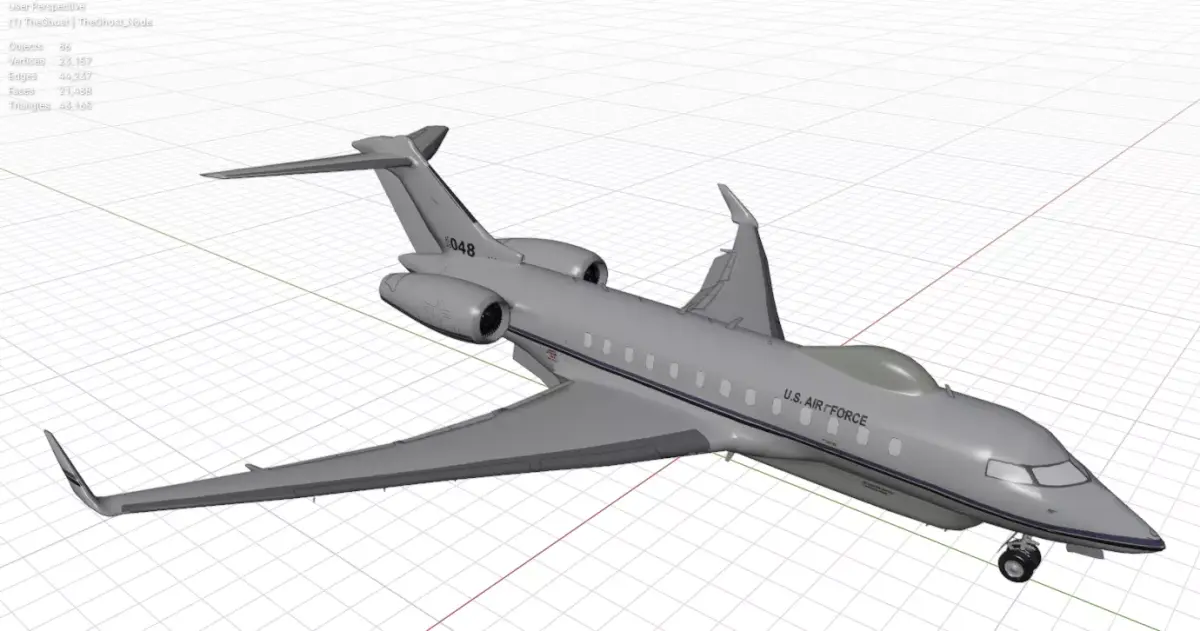
The E-11A 11-9001 BACN (Battlefield Airborne Communications Node), known as “The Ghost,” is a uniquely vital asset within the U.S. Air Force’s communications and electronic warfare capabilities. This aircraft, based on the Bombardier Global Express business jet platform, has been extensively modified to house advanced airborne communications systems designed to bridge gaps between diverse and often incompatible military communication networks. Operating primarily at high altitudes, around 51,000 feet, the E-11A provides persistent, reliable airborne communication relay coverage, especially in difficult environments such as mountainous or remote terrain where traditional line-of-sight communication is unreliable or impossible. Its mission is to serve as an airborne gateway that links air, ground, and command elements across different platforms and communication protocols, enabling seamless exchange of voice, data, and imagery in near real-time. The aircraft's sophisticated suite of software-defined radios and signal processing systems translates and relays signals among tactical radios, satellites, and other communication nodes, effectively creating a network “bridge” in the sky.
Nicknamed “The Ghost” due to its quiet, unobtrusive presence, the E-11A operates without weapons, emphasizing its role as a silent enabler rather than a direct combat asset. Its high altitude and long endurance allow it to loiter over the battlefield for hours, maintaining continuous communication coverage while remaining largely undetectable and out of harm’s way. The rarity and strategic value of the E-11A 11-9001 BACN are underscored by the small number of airframes in service and the highly specialized nature of its mission. The aircraft has been deployed extensively in operational theaters such as Afghanistan, where complex terrain and dispersed forces make reliable communication challenging. Its presence ensures that disparate units—ranging from fighter jets and unmanned aerial systems to special operations teams and ground forces—can maintain coordinated situational awareness and command control, even when separated by great distances or difficult geography.
The BACN system aboard the E-11A is capable of automatically reconfiguring to adapt to shifting tactical conditions, translating between different waveforms like Link 16, UHF/VHF radios, and satellite communications, thus overcoming interoperability challenges that might otherwise isolate units. This capability has proven critical in modern network-centric warfare, where information dominance and real-time data sharing can determine the success or failure of a mission. The E-11A’s ability to serve as a universal communication node effectively creates a seamless and resilient battlespace network, often described as providing a “Wi-Fi hotspot over the battlefield.”
The operational history of the E-11A 11-9001 BACN reflects its indispensable role in enabling joint and coalition forces to operate cohesively in contested and challenging environments. Despite the aircraft’s lack of direct combat role, its loss would severely degrade the command and control capabilities of forces relying on it. This importance was tragically highlighted in 2020 when an E-11A was lost in Afghanistan due to mechanical failure, underscoring both the risks faced by its crews and the critical nature of its mission. In summary, the E-11A 11-9001 BACN “The Ghost” stands as a silent guardian of the battlespace, an invisible yet essential force multiplier that ensures continuous, reliable communication links across the most complex and demanding operational theaters. Its presence guarantees that no unit fights in isolation, making it a cornerstone of modern military communication and coordination.
Formats include: OBJ, FBX. Feel free to check out the other models, just click on the user name to see the complete portfolio.