
Publication date: 2026-03-21
Download Glacier Shell Crawler Free 3D print model
free
License: Royalty Free No Ai
Rigged
PBR
Realtime
Animated
Free

author:
FantasyFigures
Renders and source materials belong to the author FantasyFigures.
Specifications
- Platform
- cgtrader
- Animated
- Rigged
- 3D Print ready
- VR / AR / Low-poly
- PBR
- Textures
- Materials
- UV Mapping
- Polygons
- 0
- Vertices
- 0
- Geometry
- Manifold geometry | No N-gons |
Usage recommendations
Realtime rendering
✕
PC Game development
✕
Mobile Game Development
✕
VR/AR applications
✕
Visualisation
✓
Cinema
✓
Advertising
✓
3D Printing
✓
CAD Engineering
✕
E-Commerce & Interactive 3D Web
✕
FAQ
Is this a free 3D model?
Yes, this model is available for free.
How do I download this 3D model?
Click the "Go to download" button to get this model.
What license applies to this model?
The Royalty Free No Ai license applies to this model. More details are available via the "Go to download" button.
Does it include rigging and animation?
This model has no rig or animation. It is a static 3D object.
Does this model have UV mapping?
No, this model does not have UV mapping.
What textures and materials does this 3D model include?
This model has no textures or materials.
Can I use it for 3D printing?
Yes, this model is ready for 3D printing. Complete specs can be found in the Specifications block.
Additional information
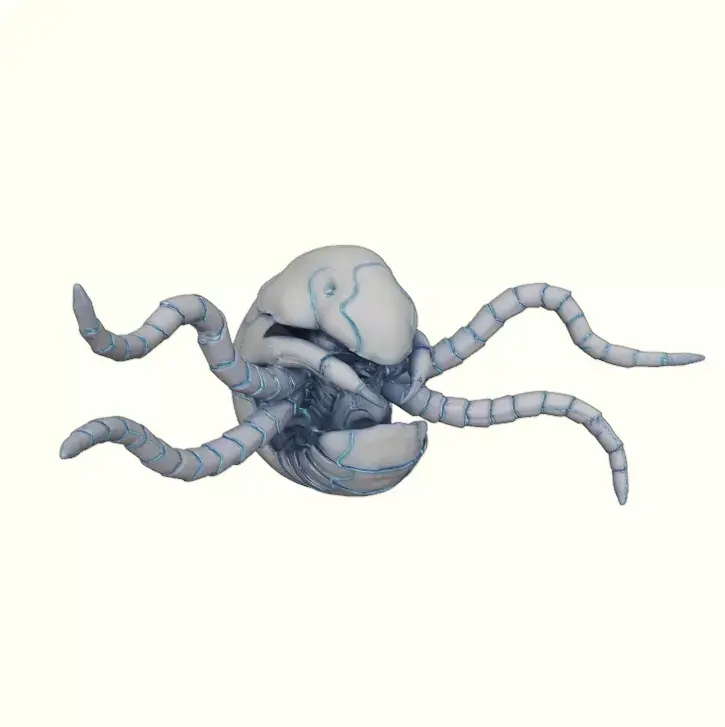
Deep below frozen seas, some creatures never learn the difference between shell and armor. They grow inside their own fortress, listening through vibration, waiting in dark water until something living brushes the wrong current. The Glacier Shell Crawler feels like one of those lifeforms: closed, patient, and difficult to read, with just enough movement in its limbs to remind you that the shell is only the beginning.
This model depicts a compact alien shell-creature with a rounded carapace, segmented tentacle-like limbs, and a partially exposed inner body tucked inside a protective outer shell. The upper and lower shell plates open just enough to reveal a dense, layered mouth structure with hooked inner appendages and sharp organic details. The outer surface stays smooth and rounded, while the seams and panel-like divisions create a clean contrast that gives the creature an unusual bio-mechanical character.
The overall silhouette is compact and distinctive. The extended limbs give it reach and visual spread, while the curled body keeps the center mass tight for display. It works well as a sci-fi specimen, alien hatchling, abyssal creature, or tabletop monster for encounters that need something strange and self-contained. The design also suits painters who enjoy cool palettes, glowing seam effects, and strong contrast between smooth shell plates and darker internal anatomy.
This model is based on an original concept and design. The initial 3D form was generated with the assistance of AI tools, after which it was extensively refined and manually detailed in Blender and other 3D editing software. This workflow ensures the figure maintains its unique character and meets the standards of precision, structure, and print-readiness required for high-quality 3D printing.
Please note that the model is primarily designed for textured versions (OBJ + MTL in ZIP archive), allowing for a rich and visually detailed result when used with color-supported 3D printing or digital rendering. The non-textured version (STL, 3MF) may lack some surface details visible in the textured formats.
Technical features and printing recommendationsRecommended print technologyResin printers for the best results on inner mouth details, shell seams, and limb segmentation.FDM printers can work at larger sizes, especially if the model is intended for display rather than fine-detail painting.Suggested resin settingsLayer height: 0.03–0.05 mmOrientation: tilt 20–30° to protect the front opening and reduce suction inside the shell cavitySupports: medium supports under the lower shell edge, limb tips, inner hooks, and exposed mouth structuresHollowing: optional at larger scales, with 2–3 mm wall thickness and drain holes hidden beneath the shellSuggested FDM settingsLayer height: 0.12–0.16 mm with a 0.4 mm nozzleWalls: 2–3 perimeters, infill 12–18%Supports: required under the front opening, limb overhangs, and inner mouth partsMaterial: PLA for easy printing, PETG for stronger limbs and tipsRecommended size, time, materialRecommended width: 90–130 mm for tabletop or shelf displaySupports: requiredMinimum print time to plan for: 360 minutesMaterial estimate at about 110 mm width: Resin 70–120 g or Filament 80–140 g, depending on hollowing and infill
Scaling Note: This model is designed in millimeters (mm). If it appears too small when imported into your slicer, ensure your software is set to mm units. If needed, scale the model up 100x if the slicer defaults to meters instead.
This model depicts a compact alien shell-creature with a rounded carapace, segmented tentacle-like limbs, and a partially exposed inner body tucked inside a protective outer shell. The upper and lower shell plates open just enough to reveal a dense, layered mouth structure with hooked inner appendages and sharp organic details. The outer surface stays smooth and rounded, while the seams and panel-like divisions create a clean contrast that gives the creature an unusual bio-mechanical character.
The overall silhouette is compact and distinctive. The extended limbs give it reach and visual spread, while the curled body keeps the center mass tight for display. It works well as a sci-fi specimen, alien hatchling, abyssal creature, or tabletop monster for encounters that need something strange and self-contained. The design also suits painters who enjoy cool palettes, glowing seam effects, and strong contrast between smooth shell plates and darker internal anatomy.
This model is based on an original concept and design. The initial 3D form was generated with the assistance of AI tools, after which it was extensively refined and manually detailed in Blender and other 3D editing software. This workflow ensures the figure maintains its unique character and meets the standards of precision, structure, and print-readiness required for high-quality 3D printing.
Please note that the model is primarily designed for textured versions (OBJ + MTL in ZIP archive), allowing for a rich and visually detailed result when used with color-supported 3D printing or digital rendering. The non-textured version (STL, 3MF) may lack some surface details visible in the textured formats.
Technical features and printing recommendationsRecommended print technologyResin printers for the best results on inner mouth details, shell seams, and limb segmentation.FDM printers can work at larger sizes, especially if the model is intended for display rather than fine-detail painting.Suggested resin settingsLayer height: 0.03–0.05 mmOrientation: tilt 20–30° to protect the front opening and reduce suction inside the shell cavitySupports: medium supports under the lower shell edge, limb tips, inner hooks, and exposed mouth structuresHollowing: optional at larger scales, with 2–3 mm wall thickness and drain holes hidden beneath the shellSuggested FDM settingsLayer height: 0.12–0.16 mm with a 0.4 mm nozzleWalls: 2–3 perimeters, infill 12–18%Supports: required under the front opening, limb overhangs, and inner mouth partsMaterial: PLA for easy printing, PETG for stronger limbs and tipsRecommended size, time, materialRecommended width: 90–130 mm for tabletop or shelf displaySupports: requiredMinimum print time to plan for: 360 minutesMaterial estimate at about 110 mm width: Resin 70–120 g or Filament 80–140 g, depending on hollowing and infill
Scaling Note: This model is designed in millimeters (mm). If it appears too small when imported into your slicer, ensure your software is set to mm units. If needed, scale the model up 100x if the slicer defaults to meters instead.
Similar models
Find the models you need