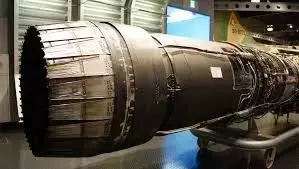
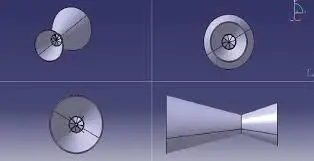
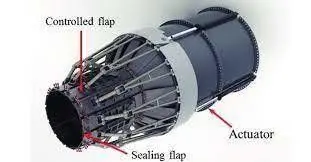
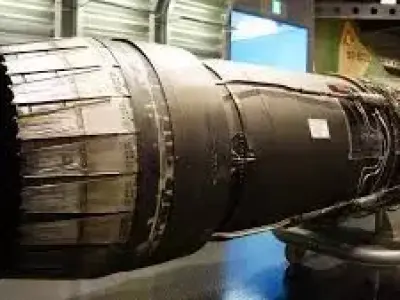
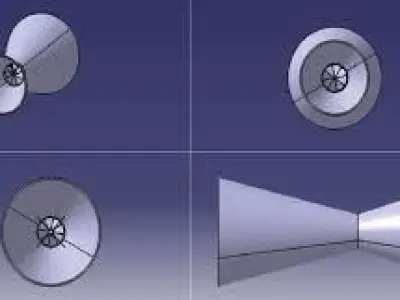
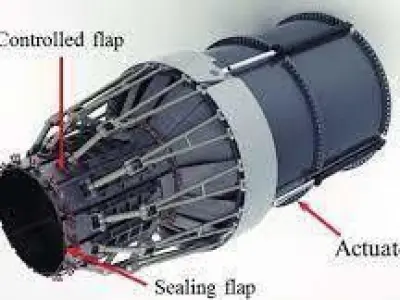
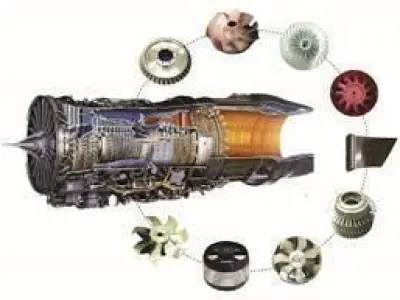
A propelling nozzle is a nozzle that converts the internal energy of a working gas into propulsive force; it is the nozzle, which forms a jet, that separates a gas turbine, being gas generator, from a jet engine.Propelling nozzles accelerate the available gas to subsonic, transonic, or supersonic velocities depending on the power setting of the engine, their internal shape and the pressures at entry to, and exit from, the nozzle. The internal shape may be convergent or convergent-divergent (C-D). C-D nozzles can accelerate the jet to supersonic velocities within the divergent section, whereas a convergent nozzle cannot accelerate the jet beyond sonic speed.FILE FORMAT:
- .CATPart
- .igs
- .obj
- .stl
- .stpA nozzle operates according to the Venturi effect to bring the exhaust gasses to ambient pressure, and thus form them into a coherent jet; if the pressure upstream of the nozzle is high enough, the flow may choke, and the jet may be supersonic. The role of the nozzle in back-pressuring the engine is explained below.The energy to accelerate the stream comes from the temperature and pressure of the gas. The gas expands adiabatically with low losses and hence high efficiency. The gas accelerates to a final exit velocity which depends on the pressure and temperature at entry to the nozzle, the ambient pressure it exhausts to (unless the flow is choked), and the efficiency of the expansion.[5] The efficiency is a measure of the losses due to friction, non-axial divergence as well as leakage in C-D nozzles.