
Publication date: 2026-05-21
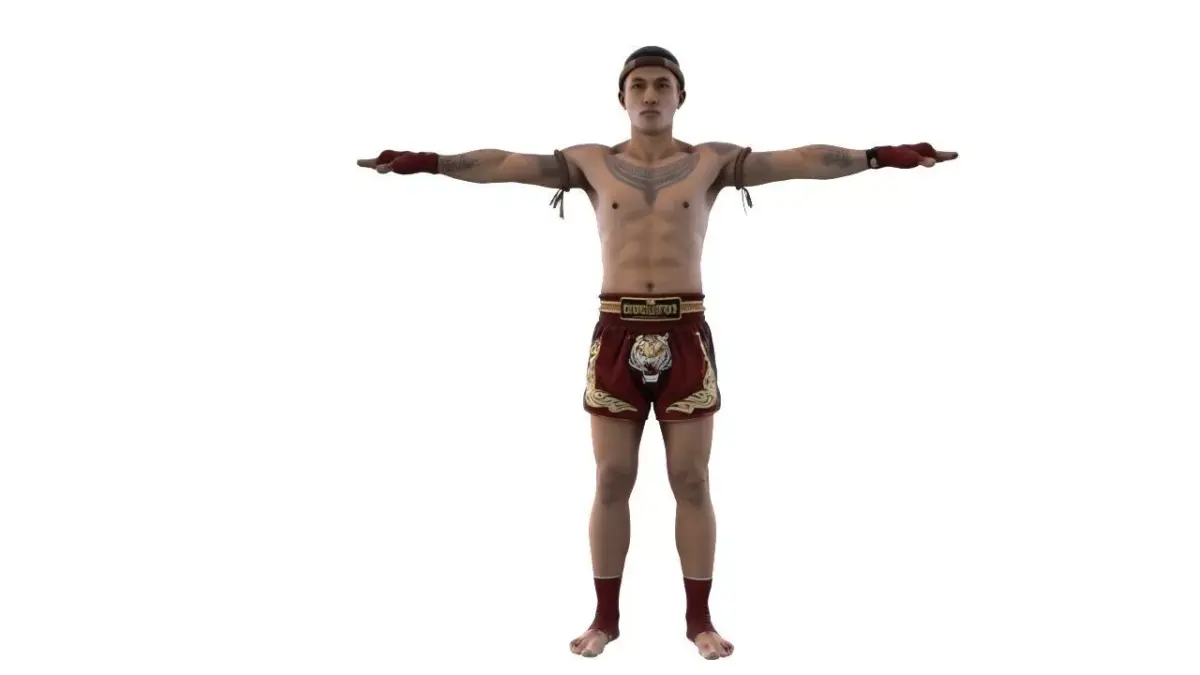
Buy Muay Thai t-pose 3D model Low-poly 3D model
$65
License: Royalty Free
Rigged
PBR
Realtime
Animated
Free
author:
salimkoc
Renders and source materials belong to the author salimkoc.
Specifications
- Platform
- cgtrader
- Animated
- Rigged
- 3D Print ready
- VR / AR / Low-poly
- PBR
- Textures
- Materials
- UV Mapping
- Polygons
- 500000
- Vertices
- 380000
- Geometry
- No N-gons | No faceted geometry | Manifold geometry |
- Plugins used
Usage recommendations
Realtime rendering
✓
PC Game development
✓
Mobile Game Development
✕
VR/AR applications
✕
Visualisation
✕
Cinema
✕
Advertising
✕
3D Printing
✕
CAD Engineering
✕
E-Commerce & Interactive 3D Web
✕
FAQ
Is this a free 3D model?
No, this model costs $65.
How do I download this 3D model?
To purchase this model, click the "Go to purchase" button.
What license applies to this model?
This model comes with a Royalty Free license. See the seller's page (via "Go to purchase") for the full terms.
Does it include rigging and animation?
This model has no rig or animation. It is a static 3D object.
Does this model have UV mapping?
Yes, this model has UV mapping. Technical details are in the Specifications block, and a fuller description is in Additional information.
What textures and materials does this 3D model include?
This model has textures and materials, including PBR. Technical details are in the Specifications block, and a fuller description is in Additional information.
Can I use it for 3D printing?
No, this model is not intended for 3D printing.
Additional information
Muay Thai or Muaythai (Thai: มวยไทย, RTGS: muai thai, pronounced [mūaj tʰāj] ⓘ), sometimes referred to as Thai boxing, the Art of Eight Limbs[5] or the Science of Eight Limbs,[6] is a Thai martial art and full-contact combat sport that uses stand-up striking, sweeps, and various clinching techniques.[7] The name “Art of Eight Limbs” refers to the combined use of fists, elbows, knees and shins.[8] Muay Thai became widespread internationally in the late 20th to 21st century, when Westernised practitioners from Thailand began competing in kickboxing and mixed-rules matches as well as matches under Muay Thai rules around the world. The professional league is governed by the Professional Boxing Association of Thailand, sanctioned by the Sports Authority of Thailand.
Muay Thai is related to other martial art styles of the Indian cultural sphere such as Musti-yuddha,[9][10] Muay Chaiya, Muay Boran, Muay Lao, Lethwei, Kun Khmer, Benjang[11] and Tomoi.[12] A practitioner of Muay Thai is known as a Nak Muay. Western practitioners in Thailand are sometimes called Nak Muay Farang, meaning foreign boxer.[13]
EtymologyThe term Muay Thai is a Thai term[14] that is a compound word made up of two basic words; muay and Thai.
The term muay is derived from the Sanskrit root word[15] mavya,[16] which means to pull together, to form into a single group or unit, or unity.[16] It is defined as to tie[17] and sport boxing[18] in Thai. The alternative form of the Sanskrit word mavya is mavy (mavyati), (Sanskrit: मव्य् (मव्यति), lit. 'to bind, to tie, to fasten.') from its root term mav.[19][20] (Sanskrit: मव)The term Thai comes from the word Tai,[15] means free[21] and Tai-Kadai speakers.[Note 1]The term Muay Thai is successor of the term Ram Mut Ram Muay[22] (Thai: รำหมัดรำมวย) since the reign of King Rama II (1809–1824), and has thus entered into the global vocabulary.[23]
The oldest text of the term Muay ever recorded is found in the palm-leaf manuscripts in Northern Thai language called Mungrai Law 1839 BE, enacted 1296 AD.[24]: 31 The pronunciation of the word Muay existed in Thai people since prior Nanzhao period[24]: 21 (738–902 AD) said in The History of Muay Thai by The Institute of the Art of Muay Thai, Department of Physical Education National Stadium of Thailand (DPE).
The historical term Tha Nai Lueak (Thai: ทนายเลือก, Thai pronunciation: [tʰá naːj lɯ̂ːak]), meaning Nak Muay for the King's guard, the name of division to be in charge of Nak Muay.[25] The term was adopted in the Law of the Military and Provincial Hierarchy 1998 BE since 1455, during the reign of King Borommatrailokkanat, and repealed during the reign (1851–1868) of King Mongkut.
Variant namesThe term Muay Thai is also written in various languages, including Polish: boks tajski,[26] Dutch: thai boxing,[27] Finnish: thainyrkkeily,[28][29] Russian: муай - тай,[30] Korean: 무에타이,[31] Japanese: ムエタイ,[32] and Chinese: 泰拳.[33]
History7th century
Statue of hermit Sukatanata, the Muay Thai martial art's progenitor, located at Khao Samo Khon hermitage, Lopburi province, Thailand, as recorded in the Yonok Chronicle[34]The earliest origin of Muay Thai dates back to the 657 AD Haripuñjaya period[24]: 17 of a hermit named Sukatanata who established his school of liberal and martial arts consisting of Muay Thai, which will be mentioned in order of history compiled officially by The Institute of the Art of Muay Thai, Department of Physical Education National Stadium of Thailand (DPE).
From 738 AD in the Nanzhao period. Muay Thai had been trained from variant movements of dance; Fon jerng[24]: 21 or jerng means tactics or finesse,[35] (Thai: ฟ้อนเจิง) included weapons and bare hands, showing the art of men's fighting, which is similar to Lei tai due to the war engagement with China for a long time. It is said to be the earliest stage of Thai people forming, and Muay Thai had been training for generations along the Fon jerng dance. The Fon jerng also became one of the recreational Thai classical dances in Northern Thailand, existing nowadays.[24]: 20
10th century
A painting of King Lavachakkaraj inside the ubosot of Wat Ming Mueang, Chiang Rai province, Thailand.After the Northern Thai people, led by King Lavachakkaraj,[24]: 29 who ruled the town of Fang (Thai: เมืองฝาง) (now Uttaradit province, Thailand), founded the Singhanavati Kingdom, known as Yonoknakhon (757–1188), they continued to expand their territory by seizing and establishing kingdoms, such as the Lan Na Kingdom, Phayao Kingdom, Haripuñjaya, and Lampang.
From 947 AD onward, they conquered various ethnic groups, including the Khom ethnic groups, aboriginal Siamese (known as Siam-asli, Saimi-mandala,[36] Siamese Lavo, Xiān, or Siam at that time), and Mon-Khmer in the upper part of the Chao Phraya River basin, using their martial arts skills (Muay). The Tai people then moved down northwest and successfully established the Sukhothai Kingdom[24]: 29 (1238–1438) under the rule of King Si Inthrathit, who was a descendant of King Phrom, a descendant of the Singhanavati Dynasty (King Lavachakkaraj). This is mentioned in the folklore, the Legend of Singhanavati.
The Mungrai Customary Law 1296 CE (Mungraiyashastra), one of the oldest palm-leaf manuscripts written in the Northern Thai language during the reign of King Mangrai, who established the town of Chiang Mai (1292–1311),[24]: 31 also mentioned the Tai martial arts (Muay) in section 7, under the article of 18 types of quarrels,[37] for the first time in the Lan Na Kingdom. In the folklore, the Legend of the Phayao Kingdom (1094–1338), the version by Wat Sriboonrueng mentioned the Tai martial arts (Muay) known as jerng tiw khui[38] during the reign of King Chueang Maharat (1115–1162).
13th centuryDuring the Pre-Ayutthaya era (Ayodhya period) before 1351, the Royal Chronicle of the North documented King Uthong's[Note 2] importation of Muay boxers from the city of Sri Phalo (now Chonburi province, Thailand) to the city-state of Ayodhya. This occurred during his reign from 1253 to 1289,[39] and a Muay boxing match between a Siamese boxer and a Chinese boxer also took place during the late reign of King Suwanracha, who ruled Ayodhya from 1301 to 1310.[39] Furthermore, the Siam-Thai of Ayutthaya (known as Gywan and Siam-Asli) launched an attack on the Thaton kingdom in 1056 CE. They expanded their territory southward and used their martial arts skills (Muay) to penetrate deep into the Malay Peninsula before 1160 CE. These events are recorded in various historical sources, including the Burmese chronicle, Hmannan Yazawin, the Malay annals (Sulalatus Salatin), and the History of the Malay Kingdom of Patani (Sejarah Kerajaan Melayu Patani).[40]
During the Sukhothai Kingdom from 1238 to 1268, Muay Thai was highly regarded as an art form and was even included in the curriculum for members of the royal family. It was seen as a way to train brave warriors with exceptional physical fitness, as well as prepare them for leadership and warfare against neighboring kingdoms.[24]: 39 King Si Inthrathit sent his second son, aged 13, Prince Ram Khamhaeng, to study Dharma, liberal arts, and martial arts (Muay) at the Samo Khon School in Lawapura town (now Lopburi province, Thailand), Lavo Kingdom. It was here that Prince Ram Khamhaeng formed a close bond with Prince Ngam Mueang, who would later become the King of Phayao Kingdom in 1258,[24]: 20 as mentioned in the Yonok Chronicles:
King Ngam Mueang of the Phayao Kingdom was the son of the ninth king, King Ming Mueang. He was a descendant of King Chom Tham, who was the son of King Khun Ngearn of Ngoenyang. At the age of 14, he received training in the principles of Brahman's sorcery[41] at Thep Isitana School, Khao Doi Duan.[Note 3] He then continued his training in liberal and martial arts (Muay) with the same instructor who had also taught King Ram Khamhaeng in Lawapura. After turning 16, he attended the Samo Khon School, established by a hermit named Sukatanata. It was here that he became comrades with King Ram Khamhaeng of Sukhothai, as they had both trained under the same instructor.[34][Note 4]
— The Yonok Chronicles: Version by the National Library of Thailand (1961).The Samo Khon school was founded in 657 AD during the Haripuñjaya period[24]: 17 by a hermit named Sukatanata (Thai: พระฤๅษีสุกกะทันตะ). He taught a variety of subjects, collectively known as Maiya Shastra (ಮೈಶಾಸ್ತ್ರ), which included martial arts (Muay), sword fighting, archery, and elephant and horse control. One of the most notable alumni of the school was King Mangrai. The Hermitage of Sukatanata still exists today and can be accessed at Wat Khao Samo Khon in Lopburi province, Thailand.[24]: 17, 18, 151
King Ram Khamhaeng also composed a war strategy manual during his reign that also mentioned Muay Thai.[24]: 40 Later, King Maha Thammaracha I was trained in essential subjects as well as practical skills, including martial arts (Muay) for self-defense with bare hands and the use of weapons. Muay Thai was also taught at temples, which served as learning centers for the Tai peoples, following the guidelines of King Ram Khamhaeng's war strategy manual.[24]: 42
Muay Thai is related to other martial art styles of the Indian cultural sphere such as Musti-yuddha,[9][10] Muay Chaiya, Muay Boran, Muay Lao, Lethwei, Kun Khmer, Benjang[11] and Tomoi.[12] A practitioner of Muay Thai is known as a Nak Muay. Western practitioners in Thailand are sometimes called Nak Muay Farang, meaning foreign boxer.[13]
EtymologyThe term Muay Thai is a Thai term[14] that is a compound word made up of two basic words; muay and Thai.
The term muay is derived from the Sanskrit root word[15] mavya,[16] which means to pull together, to form into a single group or unit, or unity.[16] It is defined as to tie[17] and sport boxing[18] in Thai. The alternative form of the Sanskrit word mavya is mavy (mavyati), (Sanskrit: मव्य् (मव्यति), lit. 'to bind, to tie, to fasten.') from its root term mav.[19][20] (Sanskrit: मव)The term Thai comes from the word Tai,[15] means free[21] and Tai-Kadai speakers.[Note 1]The term Muay Thai is successor of the term Ram Mut Ram Muay[22] (Thai: รำหมัดรำมวย) since the reign of King Rama II (1809–1824), and has thus entered into the global vocabulary.[23]
The oldest text of the term Muay ever recorded is found in the palm-leaf manuscripts in Northern Thai language called Mungrai Law 1839 BE, enacted 1296 AD.[24]: 31 The pronunciation of the word Muay existed in Thai people since prior Nanzhao period[24]: 21 (738–902 AD) said in The History of Muay Thai by The Institute of the Art of Muay Thai, Department of Physical Education National Stadium of Thailand (DPE).
The historical term Tha Nai Lueak (Thai: ทนายเลือก, Thai pronunciation: [tʰá naːj lɯ̂ːak]), meaning Nak Muay for the King's guard, the name of division to be in charge of Nak Muay.[25] The term was adopted in the Law of the Military and Provincial Hierarchy 1998 BE since 1455, during the reign of King Borommatrailokkanat, and repealed during the reign (1851–1868) of King Mongkut.
Variant namesThe term Muay Thai is also written in various languages, including Polish: boks tajski,[26] Dutch: thai boxing,[27] Finnish: thainyrkkeily,[28][29] Russian: муай - тай,[30] Korean: 무에타이,[31] Japanese: ムエタイ,[32] and Chinese: 泰拳.[33]
History7th century
Statue of hermit Sukatanata, the Muay Thai martial art's progenitor, located at Khao Samo Khon hermitage, Lopburi province, Thailand, as recorded in the Yonok Chronicle[34]The earliest origin of Muay Thai dates back to the 657 AD Haripuñjaya period[24]: 17 of a hermit named Sukatanata who established his school of liberal and martial arts consisting of Muay Thai, which will be mentioned in order of history compiled officially by The Institute of the Art of Muay Thai, Department of Physical Education National Stadium of Thailand (DPE).
From 738 AD in the Nanzhao period. Muay Thai had been trained from variant movements of dance; Fon jerng[24]: 21 or jerng means tactics or finesse,[35] (Thai: ฟ้อนเจิง) included weapons and bare hands, showing the art of men's fighting, which is similar to Lei tai due to the war engagement with China for a long time. It is said to be the earliest stage of Thai people forming, and Muay Thai had been training for generations along the Fon jerng dance. The Fon jerng also became one of the recreational Thai classical dances in Northern Thailand, existing nowadays.[24]: 20
10th century
A painting of King Lavachakkaraj inside the ubosot of Wat Ming Mueang, Chiang Rai province, Thailand.After the Northern Thai people, led by King Lavachakkaraj,[24]: 29 who ruled the town of Fang (Thai: เมืองฝาง) (now Uttaradit province, Thailand), founded the Singhanavati Kingdom, known as Yonoknakhon (757–1188), they continued to expand their territory by seizing and establishing kingdoms, such as the Lan Na Kingdom, Phayao Kingdom, Haripuñjaya, and Lampang.
From 947 AD onward, they conquered various ethnic groups, including the Khom ethnic groups, aboriginal Siamese (known as Siam-asli, Saimi-mandala,[36] Siamese Lavo, Xiān, or Siam at that time), and Mon-Khmer in the upper part of the Chao Phraya River basin, using their martial arts skills (Muay). The Tai people then moved down northwest and successfully established the Sukhothai Kingdom[24]: 29 (1238–1438) under the rule of King Si Inthrathit, who was a descendant of King Phrom, a descendant of the Singhanavati Dynasty (King Lavachakkaraj). This is mentioned in the folklore, the Legend of Singhanavati.
The Mungrai Customary Law 1296 CE (Mungraiyashastra), one of the oldest palm-leaf manuscripts written in the Northern Thai language during the reign of King Mangrai, who established the town of Chiang Mai (1292–1311),[24]: 31 also mentioned the Tai martial arts (Muay) in section 7, under the article of 18 types of quarrels,[37] for the first time in the Lan Na Kingdom. In the folklore, the Legend of the Phayao Kingdom (1094–1338), the version by Wat Sriboonrueng mentioned the Tai martial arts (Muay) known as jerng tiw khui[38] during the reign of King Chueang Maharat (1115–1162).
13th centuryDuring the Pre-Ayutthaya era (Ayodhya period) before 1351, the Royal Chronicle of the North documented King Uthong's[Note 2] importation of Muay boxers from the city of Sri Phalo (now Chonburi province, Thailand) to the city-state of Ayodhya. This occurred during his reign from 1253 to 1289,[39] and a Muay boxing match between a Siamese boxer and a Chinese boxer also took place during the late reign of King Suwanracha, who ruled Ayodhya from 1301 to 1310.[39] Furthermore, the Siam-Thai of Ayutthaya (known as Gywan and Siam-Asli) launched an attack on the Thaton kingdom in 1056 CE. They expanded their territory southward and used their martial arts skills (Muay) to penetrate deep into the Malay Peninsula before 1160 CE. These events are recorded in various historical sources, including the Burmese chronicle, Hmannan Yazawin, the Malay annals (Sulalatus Salatin), and the History of the Malay Kingdom of Patani (Sejarah Kerajaan Melayu Patani).[40]
During the Sukhothai Kingdom from 1238 to 1268, Muay Thai was highly regarded as an art form and was even included in the curriculum for members of the royal family. It was seen as a way to train brave warriors with exceptional physical fitness, as well as prepare them for leadership and warfare against neighboring kingdoms.[24]: 39 King Si Inthrathit sent his second son, aged 13, Prince Ram Khamhaeng, to study Dharma, liberal arts, and martial arts (Muay) at the Samo Khon School in Lawapura town (now Lopburi province, Thailand), Lavo Kingdom. It was here that Prince Ram Khamhaeng formed a close bond with Prince Ngam Mueang, who would later become the King of Phayao Kingdom in 1258,[24]: 20 as mentioned in the Yonok Chronicles:
King Ngam Mueang of the Phayao Kingdom was the son of the ninth king, King Ming Mueang. He was a descendant of King Chom Tham, who was the son of King Khun Ngearn of Ngoenyang. At the age of 14, he received training in the principles of Brahman's sorcery[41] at Thep Isitana School, Khao Doi Duan.[Note 3] He then continued his training in liberal and martial arts (Muay) with the same instructor who had also taught King Ram Khamhaeng in Lawapura. After turning 16, he attended the Samo Khon School, established by a hermit named Sukatanata. It was here that he became comrades with King Ram Khamhaeng of Sukhothai, as they had both trained under the same instructor.[34][Note 4]
— The Yonok Chronicles: Version by the National Library of Thailand (1961).The Samo Khon school was founded in 657 AD during the Haripuñjaya period[24]: 17 by a hermit named Sukatanata (Thai: พระฤๅษีสุกกะทันตะ). He taught a variety of subjects, collectively known as Maiya Shastra (ಮೈಶಾಸ್ತ್ರ), which included martial arts (Muay), sword fighting, archery, and elephant and horse control. One of the most notable alumni of the school was King Mangrai. The Hermitage of Sukatanata still exists today and can be accessed at Wat Khao Samo Khon in Lopburi province, Thailand.[24]: 17, 18, 151
King Ram Khamhaeng also composed a war strategy manual during his reign that also mentioned Muay Thai.[24]: 40 Later, King Maha Thammaracha I was trained in essential subjects as well as practical skills, including martial arts (Muay) for self-defense with bare hands and the use of weapons. Muay Thai was also taught at temples, which served as learning centers for the Tai peoples, following the guidelines of King Ram Khamhaeng's war strategy manual.[24]: 42
Similar models



Find the models you need