High-quality 3D assets at affordable prices — trusted by designers, engineers, and creators worldwide. Made with care to be versatile, accessible, and ready for your pipeline.
Included File Formats
This model is provided in 14 widely supported formats, ensuring maximum compatibility:
• - FBX (.fbx) – Standard format for most 3D software and pipelines
• - OBJ + MTL (.obj, .mtl) – Wavefront format, widely used and compatible
• - STL (.stl) – Exported mesh geometry; may be suitable for 3D printing with adjustments
• - STEP (.step, .stp) – CAD format using NURBS surfaces
• - IGES (.iges, .igs) – Common format for CAD/CAM and engineering workflows (NURBS)
• - SAT (.sat) – ACIS solid model format (NURBS)
• - DAE (.dae) – Collada format for 3D applications and animations
• - glTF (.glb) – Modern, lightweight format for web, AR, and real-time engines
• - 3DS (.3ds) – Legacy format with broad software support
• - 3ds Max (.max) – Provided for 3ds Max users
• - Blender (.blend) – Provided for Blender users
• - SketchUp (.skp) – Compatible with all SketchUp versions
• - AutoCAD (.dwg) – Suitable for technical and architectural workflows
• - Rhino (.3dm) – Provided for Rhino users
Model Info
• - All files are checked and tested for integrity and correct content
• - Geometry uses real-world scale; model resolution varies depending on the product (high or low poly)
• • - Scene setup and mesh structure may vary depending on model complexity
• - Rendered using Luxion KeyShot
• - Affordable price with professional detailing
Buy with confidence. Quality and compatibility guaranteed.
If you have any questions about the file formats, feel free to send us a message — we're happy to assist you!
Sincerely,
SURF3D
Trusted source for professional and affordable 3D models.
More Information About 3D Model :
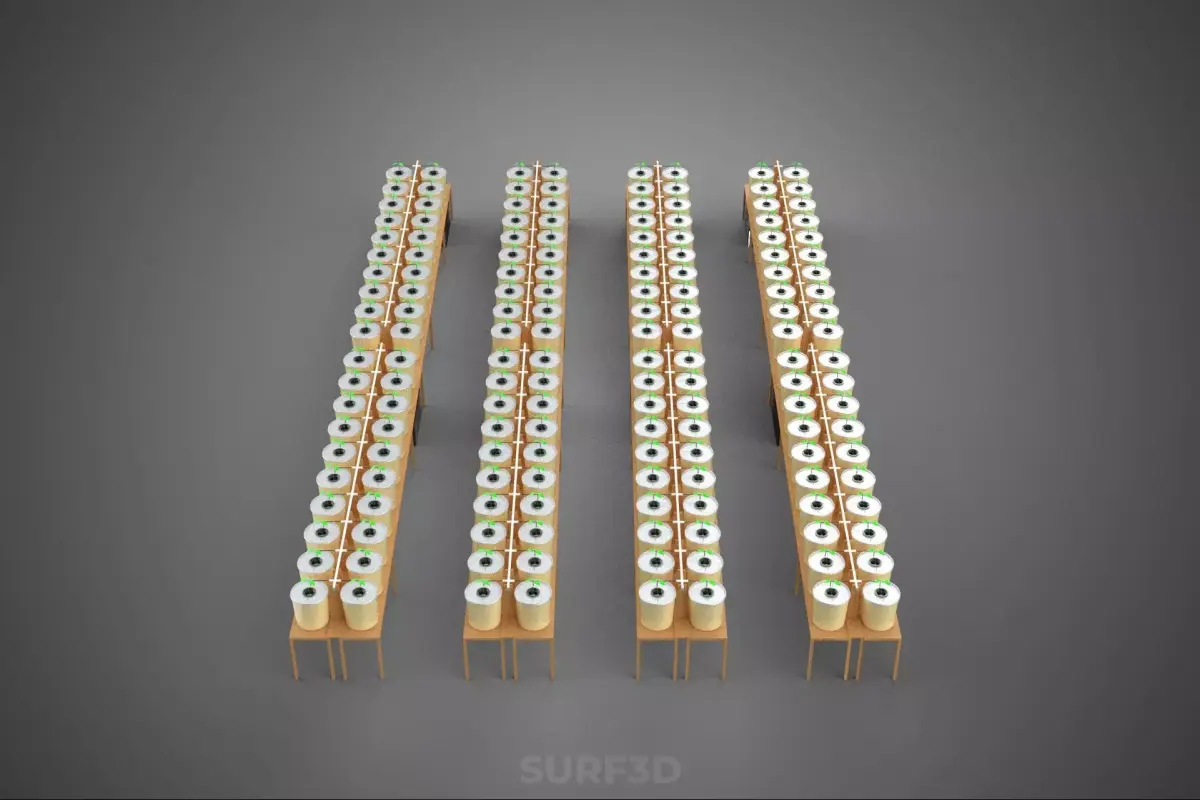
The Technical Diagram for a Modular Dutch Bucket Indoor Hydroponic System illustrates a highly efficient, scalable method for soilless crop cultivation within a controlled environment, typically characterized as Controlled Environment Agriculture (CEA). This system, also known colloquially as the Bato Bucket system, operates on a recirculating hydroponic principle, providing precise delivery of nutrient solution to individual plant containers while minimizing water waste and operational complexity.
Operational Principle
The Dutch Bucket system is fundamentally a closed-loop recirculating drip irrigation arrangement. The core mechanism involves delivering nutrient-rich water from a central reservoir through a pressurized supply line to individual growing containers (Dutch Buckets). A timer controls the frequency and duration of these irrigation cycles.
The key feature of the Dutch Bucket design is the controlled drainage mechanism. Each bucket is equipped with an overflow elbow or siphon tube, ensuring that the inert growing medium (e.g., perlite, coco coir, or rockwool) remains saturated to a specific height (typically 1–2 inches) before excess solution drains out. This ensures adequate aeration to the root zone while maintaining constant hydration. The drained solution is collected via a PVC return manifold (drain line), which gravity-feeds the unused nutrient solution back to the central reservoir for filtration, replenishment, and eventual recirculation. This recirculation capability significantly enhances water and nutrient use efficiency compared to traditional non-recirculating systems.
Modular Configuration and Components
The technical diagram highlights the system's modularity, allowing for flexible expansion and contraction based on crop load and spatial constraints.
1. The Dutch Bucket Unit
Each unit, usually constructed of food-grade, UV-resistant plastic, is designed to accommodate large, fruiting crops such as tomatoes, cucumbers, peppers, or vine crops. The typical bucket volume ranges from 10 to 12 liters. The bottom of the bucket contains the drainage orifice positioned above the supply line, ensuring gravitational flow into the return line. The inert medium provides physical support for the plant structure without contributing nutrients.
2. Nutrient Delivery System
This component includes a high-volume, low-pressure submersible pump situated within the reservoir. The pump pushes the solution through a main supply line (header line), which branches into smaller feeder lines (spaghetti tubing), each connected to a pressure-compensating drip emitter placed at the base of the plant in the bucket. The use of pressure-compensating emitters ensures uniform delivery rates across the entire system, regardless of the distance from the pump.
3. Recirculation and Monitoring
The reservoir acts as the central hub for the nutrient solution. Integrated technical instruments are necessary for system management:
- pH Meter/Controller: Essential for maintaining the optimal acidity range (typically 5.5 to 6.5) for nutrient uptake.
- EC Meter (Electrical Conductivity): Monitors the concentration of dissolved mineral salts (nutrients) in the water.
- Aeration Device: An air pump and air stone ensure sufficient dissolved oxygen in the reservoir to prevent root disease and stagnation.
#### 4. Indoor Environment Integration
As an indoor system, the diagram accounts for the necessity of supplementary technical infrastructure critical for plant health:
- Supplemental Lighting: High-intensity discharge (HID), LED, or fluorescent fixtures provide the necessary photosynthetic active radiation (PAR).
- Environmental Controls: HVAC systems manage temperature and humidity, while carbon dioxide (CO2) enrichment may be implemented to maximize photosynthetic efficiency and yield.
### Technical Advantages
The modular Dutch Bucket system is favored in commercial applications due to its high degree of control, accessibility for plant maintenance, and the isolation of individual buckets. This isolation prevents the rapid spread of root-borne pathogens across the entire system, a vulnerability often associated with systems like Deep Water Culture (DWC) or Nutrient Film Technique (NFT). Furthermore, the design supports efficient water resource management and precise nutrient management, which are hallmarks of sustainable modern CEA operations.
KEYWORDS: Hydroponics, Bato Bucket, CEA, Modular System, Recirculation, Closed-loop, Drip Irrigation, Submersible Pump, Inert Medium, Perlite, Coco Coir, Nutrient Solution, pH Management, EC Monitoring, Drainage Manifold, Controlled Environment, Indoor Farming, Soilless Culture, Technical Diagram, Irrigation Timer, Overflow Siphon, Greenhouse Technology, Horticulture, Crop Yield, Scalability, Plant Architecture, Water Efficiency, Supply Line, Return Line, Grow Light.
STL (Stereolithography, filesize: 441 MB), OBJ (OBJ, filesize: 1.02 GB), IGE (IGES, filesize: 23.6 MB), 3DM (Rhinoceros 3D, filesize: 34.4 MB), STP (STEP, filesize: 13.5 MB), SAT (3D ACIS, filesize: 1.04 GB), MAX (Autodesk 3ds Max, filesize: 1.89 GB), DAE (Collada, filesize: 1.47 GB), BLEND (Blender, filesize: 792 MB), FBX (Autodesk FBX, filesize: 287 MB), GLTF (glTF, filesize: 292 MB), 3DS (3D Studio, filesize: 273 MB), DWG (AutoCAD, filesize: 216 MB), SKP (Sketchup, filesize: 14.9 MB)