
Publication date: 2026-01-21
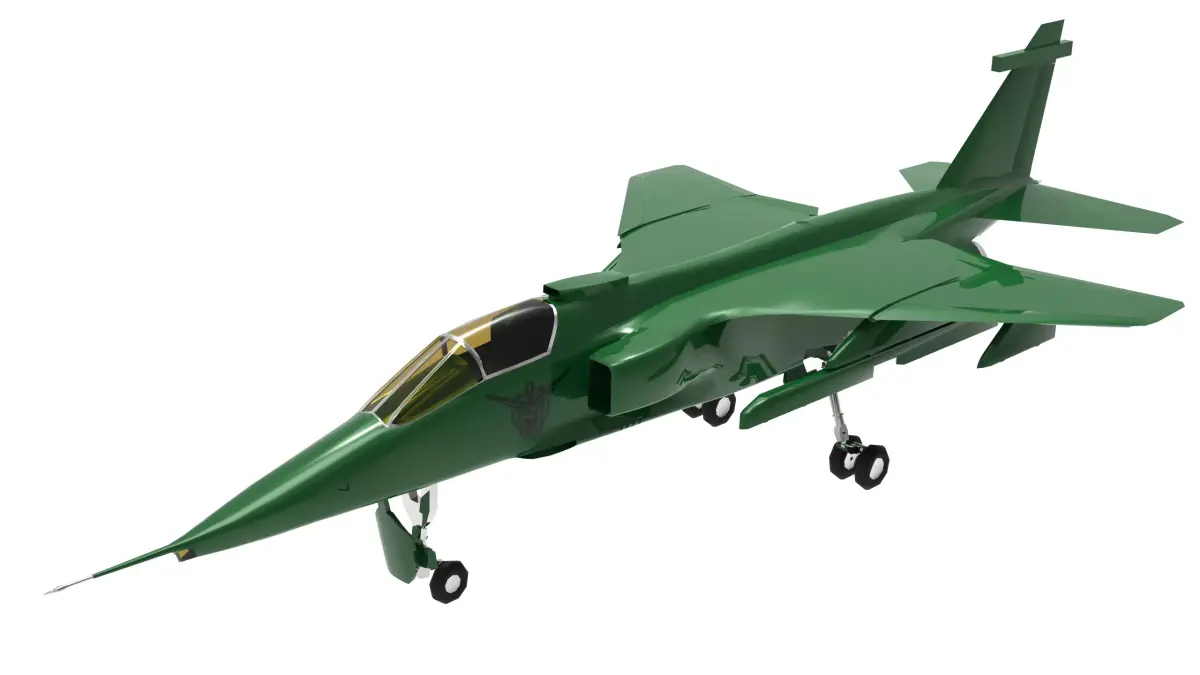
Buy The SEPECAT Jaguar Low-poly 3D model
$14.65
License: Royalty Free
Rigged
PBR
Realtime
Animated
Free
Renders and source materials belong to the author daniellababan.
Specifications
- Platform
- cgtrader
- Animated
- Rigged
- 3D Print ready
- VR / AR / Low-poly
- PBR
- Textures
- Materials
- UV Mapping
- Polygons
- 0
- Vertices
- 0
- Geometry
- No N-gons | No faceted geometry | Manifold geometry |
Usage recommendations
Realtime rendering
✓
PC Game development
✓
Mobile Game Development
✓
VR/AR applications
✓
Visualisation
✕
Cinema
✕
Advertising
✕
3D Printing
✕
CAD Engineering
✕
E-Commerce & Interactive 3D Web
✓
FAQ
Is this a free 3D model?
No, this model costs $14.65.
How do I download this 3D model?
Click the "Go to purchase" button to buy and download this model.
What license applies to this model?
This model comes with a Royalty Free license. See the seller's page (via "Go to purchase") for the full terms.
Does it include rigging and animation?
This model has no rig or animation. It is a static 3D object.
Does this model have UV mapping?
No, this model does not have UV mapping.
What textures and materials does this 3D model include?
This model has textures and materials. Detailed specs are listed in the Specifications block.
Can I use it for 3D printing?
No, this model is not intended for 3D printing.
Additional information
The SEPECAT Jaguar is a British-French supersonic jet attack aircraft originally used by the British Royal Air Force and the French Air Force in the close air support and nuclear strike role. As of 2025, the Jaguar remains in service with the Indian Air Force.
Originally conceived in the 1960s as a jet trainer with a light ground attack capability, the requirement for the aircraft changed to include supersonic performance, reconnaissance and tactical nuclear strike roles. The aircraft were manufactured by SEPECAT (Société Européenne de Production de l'avion Ecole de Combat et d'Appui Tactique), a joint venture between Breguet and the British Aircraft Corporation, one of the first major joint British-French military aircraft programmes. It was also later license produced by Hindustan Aeronautics Limited in India for use of the Indian Air Force. Various single and two–seater variants of the aircraft have been developed over the years, including a maritime strike version. A carrier-based variant was also planned for French Navy service, but this was cancelled in favour of the cheaper, fully French-built Dassault-Breguet Super Étendard.
The Jaguar was exported to India, Oman, Ecuador and Nigeria, and was used in conflicts and military operations in Bosnia, Chad, Iraq, Mauritania, and Pakistan. It provided a ready nuclear delivery platform for the United Kingdom, France, and India throughout the latter years of the Cold War and beyond. In the Gulf War, the Jaguar was praised for its reliability and was a valuable resource for the Coalition. The aircraft served as a strike/attack aircraft with the French Air Force until 1 July 2005, and with the Royal Air Force until the end of April 2007.
Originally conceived in the 1960s as a jet trainer with a light ground attack capability, the requirement for the aircraft changed to include supersonic performance, reconnaissance and tactical nuclear strike roles. The aircraft were manufactured by SEPECAT (Société Européenne de Production de l'avion Ecole de Combat et d'Appui Tactique), a joint venture between Breguet and the British Aircraft Corporation, one of the first major joint British-French military aircraft programmes. It was also later license produced by Hindustan Aeronautics Limited in India for use of the Indian Air Force. Various single and two–seater variants of the aircraft have been developed over the years, including a maritime strike version. A carrier-based variant was also planned for French Navy service, but this was cancelled in favour of the cheaper, fully French-built Dassault-Breguet Super Étendard.
The Jaguar was exported to India, Oman, Ecuador and Nigeria, and was used in conflicts and military operations in Bosnia, Chad, Iraq, Mauritania, and Pakistan. It provided a ready nuclear delivery platform for the United Kingdom, France, and India throughout the latter years of the Cold War and beyond. In the Gulf War, the Jaguar was praised for its reliability and was a valuable resource for the Coalition. The aircraft served as a strike/attack aircraft with the French Air Force until 1 July 2005, and with the Royal Air Force until the end of April 2007.
Similar models
Find the models you need