
Publication date: May 04, 2021
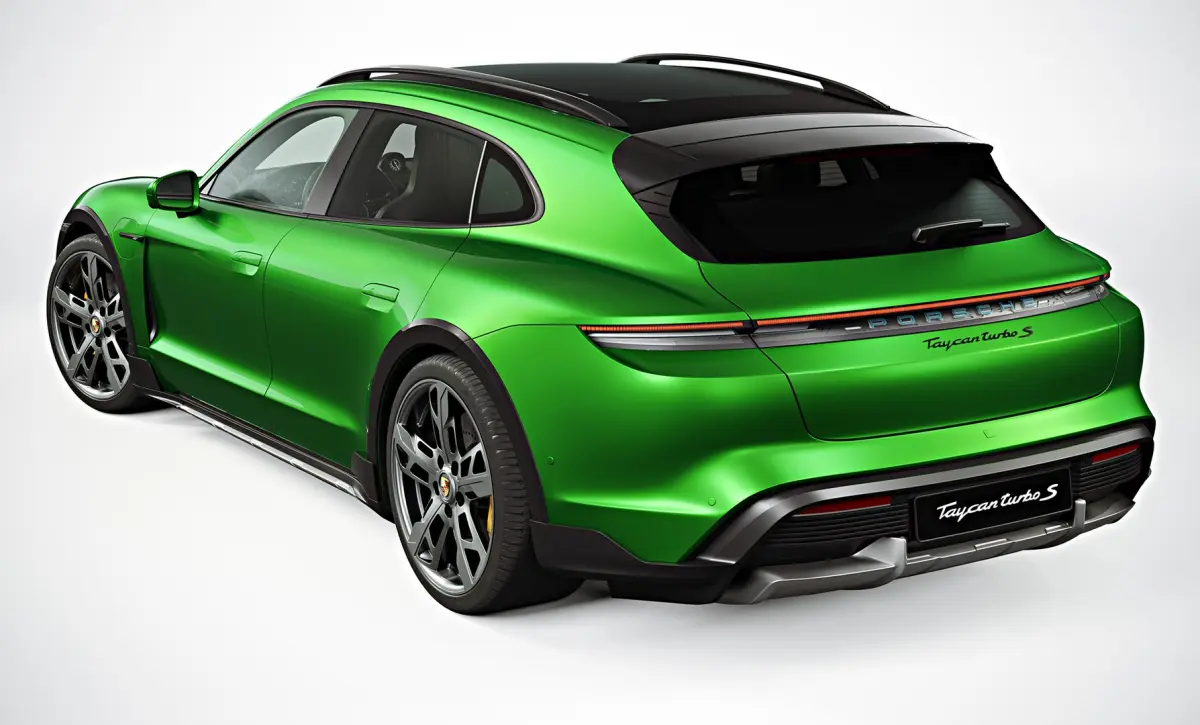
Buy 2022 Porsche Taycan Cross Turismo 3D model purchase
$149
License: Editorial Uses Only
Rigged
PBR
Realtime
Animated
Free
Renders and source materials belong to the author HKV Studios.
Specifications
- Platform
- turbosquid
- Animated
- Rigged
- 3D Print ready
- VR / AR / Low-poly
- PBR
- Textures
- Materials
- UV Mapping
- Polygons
- 274868
- Vertices
- 302183
- Geometry
- Unknown
Usage recommendations
Realtime rendering
✕
PC Game development
✕
Mobile Game Development
✕
VR/AR applications
✕
Visualisation
✓
Cinema
✓
Advertising
✓
3D Printing
✕
CAD Engineering
✕
E-Commerce & Interactive 3D Web
✕
FAQ
Is this a free 3D model?
No, this model costs $149.
How do I download this 3D model?
To purchase this model, click the "Go to purchase" button.
What license applies to this model?
This model is distributed under the Editorial Uses Only license. Click "Go to purchase" for full license details.
Does it include rigging and animation?
This model has no rig or animation. It is a static 3D object.
Does this model have UV mapping?
Yes, this model has UV mapping. Check the Specifications block for technical details and Additional information for the full picture.
What textures and materials does this 3D model include?
This model has textures and materials. Check the Specifications block for technical details and Additional information for the full picture.
Can I use it for 3D printing?
No, this model is not intended for 3D printing.
Additional information
Photorealistic, high-quality and accurate 3D model of 2022 Porsche Taycan Cross Turismo with high detailed interior.
The model is suitable for Ultra HD rendering and further use in broadcast, high-res film close-up, advertising, etc.
The model can be also used in real-time applications (Unreal Engine, Unity and etc.) after a number of mesh optimizations, texture backing and other procedures executed on the customer's side.
The studio rendering quality shown on product previews is reachable "out-of-box" with no need of any additional manipulations, if you use 3ds max + Corona native file format.
Just download and hit "Render"!
Main features:
- Originally created with 3ds Max 2015
- Two MAX files with Corona and Standard 3ds Max materials
- Subdivision modifier is available in the history for MAX, MB and C4D file formats. You can get access to original non-smoothed mesh by deactivating the Subdiv modifier
- Separate objects like body, wheels and doors. Total number of objects is 27
- Doors can be opened
- Unit system is set to metric (millimeters). Real-world scale
- All textures and materials are included and assigned
- 23 textures, which vary in resolution from 128x128px to 4000x4000px
- Windshield, rear window and back side windows are using high resolution transparency mask texture
- Previews rendered in 3ds Max 2015 with Corona 5.0
Special notes:
- FBX and OBJ formats are recommended for import in other 3d software. If your software doesn't support FBX or OBJ format, please use 3DS format; FBX and OBJ formats were exported from 3ds Max. The geometry for FBX and OBJ formats is set to quads
- FBX format is recommended for importing in real-time engines like Unreal Engine, Unity and etc.
- MAX files can be loaded in Autodesk 3ds Max 2015 or higher. In order to use Corona rendering setups and materials, Corona 3.0 or higher is needed
- C4D file can be loaded in MAXON Cinema4D R17 or higher. Only standard Cinema4D materials and standard renderer used
- MB file can be loaded in Autodesk Maya 2015 or higher. Only standard Maya materials and standard Hardware 2.0 renderer used
Polycounts:
MAX format (one file included with TurboSmooth iteration 1 applied to all objects):
no TurboSmooth: 274,868 faces and 302,183 vertices
TurboSmooth iteration 1: 1,096,120 faces and 1,152,967 vertices
TurboSmooth iteration 2: 4,384,480 faces and 4,497,039 vertices
MB and C4D formats (only one file for each format included with Subdivision iteration 1 applied to all objects):
no Subdiv: 274,868 faces and 302,183 vertices
Subdiv iteration 1: 1,096,120 faces and 1,152,967 vertices
Subdiv iteration 2: 4,384,480 faces and 4,497,039 vertices
FBX and OBJ formats (3 files included for each format):
low: 274,868 faces and 302,183 vertices
medium: 1,096,120 faces and 1,152,967 vertices
high: 4,384,480 faces and 4,497,039 vertices
3DS format (3 files included):
low: 546,384 faces and 358,194 vertices
medium: 2,192,240 faces and 1,272,652 vertices
high: 8,768,960 faces and 4,822,763 vertices
The model is suitable for Ultra HD rendering and further use in broadcast, high-res film close-up, advertising, etc.
The model can be also used in real-time applications (Unreal Engine, Unity and etc.) after a number of mesh optimizations, texture backing and other procedures executed on the customer's side.
The studio rendering quality shown on product previews is reachable "out-of-box" with no need of any additional manipulations, if you use 3ds max + Corona native file format.
Just download and hit "Render"!
Main features:
- Originally created with 3ds Max 2015
- Two MAX files with Corona and Standard 3ds Max materials
- Subdivision modifier is available in the history for MAX, MB and C4D file formats. You can get access to original non-smoothed mesh by deactivating the Subdiv modifier
- Separate objects like body, wheels and doors. Total number of objects is 27
- Doors can be opened
- Unit system is set to metric (millimeters). Real-world scale
- All textures and materials are included and assigned
- 23 textures, which vary in resolution from 128x128px to 4000x4000px
- Windshield, rear window and back side windows are using high resolution transparency mask texture
- Previews rendered in 3ds Max 2015 with Corona 5.0
Special notes:
- FBX and OBJ formats are recommended for import in other 3d software. If your software doesn't support FBX or OBJ format, please use 3DS format; FBX and OBJ formats were exported from 3ds Max. The geometry for FBX and OBJ formats is set to quads
- FBX format is recommended for importing in real-time engines like Unreal Engine, Unity and etc.
- MAX files can be loaded in Autodesk 3ds Max 2015 or higher. In order to use Corona rendering setups and materials, Corona 3.0 or higher is needed
- C4D file can be loaded in MAXON Cinema4D R17 or higher. Only standard Cinema4D materials and standard renderer used
- MB file can be loaded in Autodesk Maya 2015 or higher. Only standard Maya materials and standard Hardware 2.0 renderer used
Polycounts:
MAX format (one file included with TurboSmooth iteration 1 applied to all objects):
no TurboSmooth: 274,868 faces and 302,183 vertices
TurboSmooth iteration 1: 1,096,120 faces and 1,152,967 vertices
TurboSmooth iteration 2: 4,384,480 faces and 4,497,039 vertices
MB and C4D formats (only one file for each format included with Subdivision iteration 1 applied to all objects):
no Subdiv: 274,868 faces and 302,183 vertices
Subdiv iteration 1: 1,096,120 faces and 1,152,967 vertices
Subdiv iteration 2: 4,384,480 faces and 4,497,039 vertices
FBX and OBJ formats (3 files included for each format):
low: 274,868 faces and 302,183 vertices
medium: 1,096,120 faces and 1,152,967 vertices
high: 4,384,480 faces and 4,497,039 vertices
3DS format (3 files included):
low: 546,384 faces and 358,194 vertices
medium: 2,192,240 faces and 1,272,652 vertices
high: 8,768,960 faces and 4,822,763 vertices
Similar models
Find the models you need