
Publication date: 2026-01-13
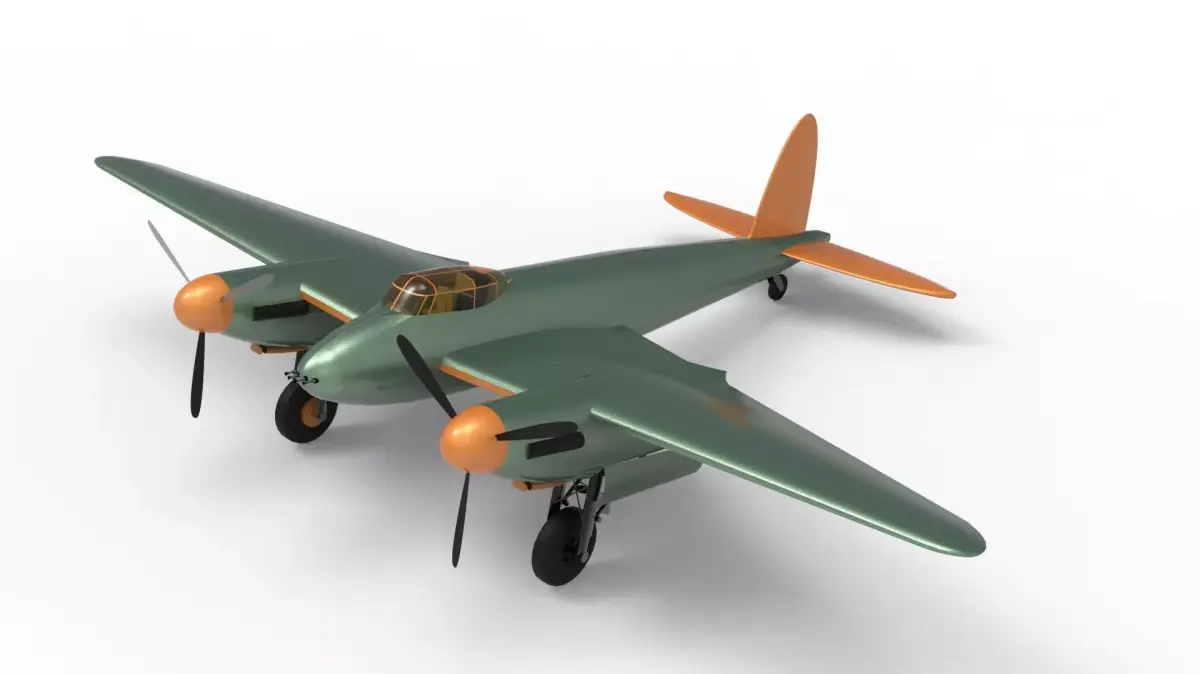
Buy De Havilland Mosquito Low-poly 3D model
$10.78
License: Royalty Free
Rigged
PBR
Realtime
Animated
Free
Renders and source materials belong to the author daniellababan.
Specifications
- Platform
- cgtrader
- Animated
- Rigged
- 3D Print ready
- VR / AR / Low-poly
- PBR
- Textures
- Materials
- UV Mapping
- Polygons
- 0
- Vertices
- 0
- Geometry
- No N-gons | No faceted geometry | Manifold geometry |
Usage recommendations
Realtime rendering
✓
PC Game development
✓
Mobile Game Development
✓
VR/AR applications
✓
Visualisation
✕
Cinema
✕
Advertising
✕
3D Printing
✕
CAD Engineering
✕
E-Commerce & Interactive 3D Web
✓
FAQ
Is this a free 3D model?
No, this model costs $10.78.
How do I download this 3D model?
Use the "Go to purchase" button below to get this model.
What license applies to this model?
This model is distributed under the Royalty Free license. Click "Go to purchase" for full license details.
Does it include rigging and animation?
This model has no rig or animation. It is a static 3D object.
Does this model have UV mapping?
No, this model does not have UV mapping.
What textures and materials does this 3D model include?
This model has textures and materials. The exact technical parameters are listed in the Specifications block.
Can I use it for 3D printing?
No, this model is not intended for 3D printing.
Additional information
The de Havilland DH.98 Mosquito is a British twin-engined, multirole combat aircraft, introduced during the Second World War. Unusual in that its airframe was constructed mostly of wood, it was nicknamed the Wooden Wonder, or Mossie. In 1941, it was one of the fastest operational aircraft in the world.
Originally conceived as an unarmed fast bomber, the Mosquito's use evolved during the war into many roles, including low- to medium-altitude daytime tactical bomber, high-altitude night bomber, pathfinder, day or night fighter, fighter-bomber, intruder, maritime strike, and photo-reconnaissance aircraft. It was also used by the British Overseas Airways Corporation as a fast transport to carry small, high-value cargo to and from neutral countries through enemy-controlled airspace. The crew of two, pilot and navigator, sat side by side. A single passenger could ride in the aircraft's bomb bay when necessary.
The Mosquito FB Mk. VI was often flown in special raids, such as Operation Jericho (an attack on Amiens Prison in early 1944), and precision attacks against military intelligence, security, and police facilities (such as Gestapo headquarters). On 30 January 1943, the 10th anniversary of Hitler being made chancellor and the Nazis gaining power, a morning Mosquito attack knocked out the main Berlin broadcasting station while Hermann Göring was speaking, taking his speech off the air.
The Mosquito flew with the Royal Air Force (RAF) and other air forces in the European, Mediterranean, and Italian theatres. The Mosquito was also operated by the RAF in the Southeast Asian theatre and by the Royal Australian Air Force based in the Moluccas and Borneo during the Pacific War. During the 1950s, the RAF replaced the Mosquito with the jet-powered English Electric Canberra.
Originally conceived as an unarmed fast bomber, the Mosquito's use evolved during the war into many roles, including low- to medium-altitude daytime tactical bomber, high-altitude night bomber, pathfinder, day or night fighter, fighter-bomber, intruder, maritime strike, and photo-reconnaissance aircraft. It was also used by the British Overseas Airways Corporation as a fast transport to carry small, high-value cargo to and from neutral countries through enemy-controlled airspace. The crew of two, pilot and navigator, sat side by side. A single passenger could ride in the aircraft's bomb bay when necessary.
The Mosquito FB Mk. VI was often flown in special raids, such as Operation Jericho (an attack on Amiens Prison in early 1944), and precision attacks against military intelligence, security, and police facilities (such as Gestapo headquarters). On 30 January 1943, the 10th anniversary of Hitler being made chancellor and the Nazis gaining power, a morning Mosquito attack knocked out the main Berlin broadcasting station while Hermann Göring was speaking, taking his speech off the air.
The Mosquito flew with the Royal Air Force (RAF) and other air forces in the European, Mediterranean, and Italian theatres. The Mosquito was also operated by the RAF in the Southeast Asian theatre and by the Royal Australian Air Force based in the Moluccas and Borneo during the Pacific War. During the 1950s, the RAF replaced the Mosquito with the jet-powered English Electric Canberra.
Similar models
Find the models you need