
Publication date: 2026-05-21
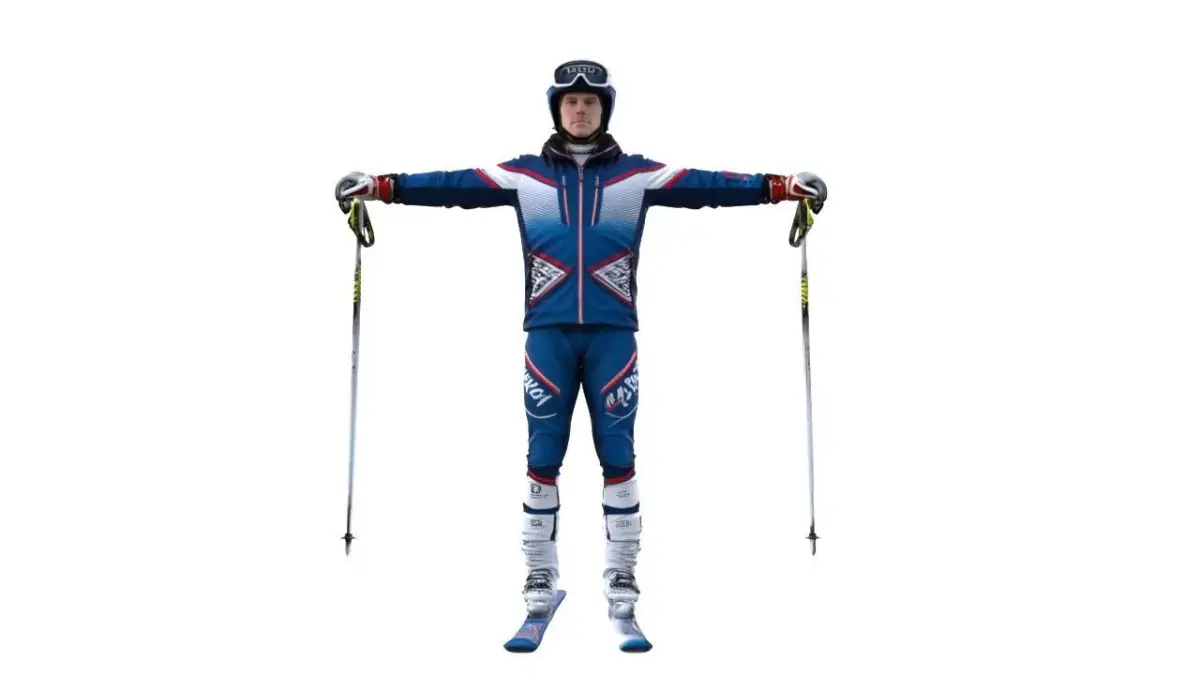
Buy skier t-pose 3D model Low-poly 3D model
$65
License: Royalty Free
Rigged
PBR
Realtime
Animated
Free

author:
salimkoc
Renders and source materials belong to the author salimkoc.
Specifications
- Platform
- cgtrader
- Animated
- Rigged
- 3D Print ready
- VR / AR / Low-poly
- PBR
- Textures
- Materials
- UV Mapping
- Polygons
- 500000
- Vertices
- 380000
- Geometry
- No N-gons | No faceted geometry | Manifold geometry |
- Plugins used
Usage recommendations
Realtime rendering
✓
PC Game development
✓
Mobile Game Development
✕
VR/AR applications
✕
Visualisation
✕
Cinema
✕
Advertising
✕
3D Printing
✕
CAD Engineering
✕
E-Commerce & Interactive 3D Web
✕
FAQ
Is this a free 3D model?
No, this model costs $65.
How do I download this 3D model?
Click the "Go to purchase" button to buy and download this model.
What license applies to this model?
This model comes with a Royalty Free license. See the seller's page (via "Go to purchase") for the full terms.
Does it include rigging and animation?
This model has no rig or animation. It is a static 3D object.
Does this model have UV mapping?
Yes, this model has UV mapping. Full technical parameters are outlined in the Specifications block.
What textures and materials does this 3D model include?
This model has textures and materials, including PBR. Full technical parameters are outlined in the Specifications block.
Can I use it for 3D printing?
No, this model is not intended for 3D printing.
Additional information
Skiing is the use of skis to glide on snow for basic transport, a recreational activity, or a competitive winter sport. Many types of competitive skiing events are recognized by the International Olympic Committee (IOC), and the International Ski and Snowboard Federation (FIS).
HistoryMain article: History of skiingDuration: 1 minute and 28 seconds.1:28Video demonstration of a variety of ski techniques used in the 1940s.Skiing has a history of almost five millennia.[1] Although modern skiing has evolved from beginnings in Scandinavia, it may have been practiced more than 100 centuries ago in the Altai Mountains, according to an interpretation of ancient paintings.[2][3] However, this continues to be debated.[4][5]
The word ski comes from the Old Norse word skíð which means to split piece of wood or firewood.[6]
Asymmetrical skis were used in northern Finland and Sweden until at least the late 19th century. On one foot, the skier wore a long straight non-arching ski for sliding, and a shorter ski was worn on the other foot for kicking. The underside of the short ski was either plain or covered with animal skin to aid this use, while the long ski supporting the weight of the skier was treated with animal fat in a similar manner to modern ski waxing.
Early skiers used one long pole or spear. The first description of a skier with two ski poles dates to 1741.[7]
Troops in continental Europe were equipped with skis by 1747,[8] and into the 21st century many nations continue to equip and train specialized troops for ski warfare.
Skiing was primarily used for transport until the mid-19th century but, since then, it has also become a recreation and sport.[9] Military ski races were held in Norway during the 18th century,[10] and ski warfare was studied in the late 18th century.[11] As equipment evolved and ski lifts were developed during the late 19th and early 20th centuries, two main genres of skiing emerged—Alpine (downhill) skiing and Nordic skiing. The main difference between the two is the type of ski binding (the way in which the ski boots are attached to the skis).
TypesAlpineMain article: Alpine skiingAlso called downhill skiing, Alpine skiing typically takes place on a piste at a ski resort. It is characterized by fixed-heel bindings that attach at both the toe and the heel of the skier's boot. Ski lifts, including chairlifts, bring skiers up the slope. Backcountry skiing can be accessed by helicopter, snowcat, hiking and snowmobile. Facilities at resorts can include night skiing, après-ski, and glade skiing, usually under the supervision of the ski patrol and/or a ski school. Alpine skiing branched off from the older Nordic type of skiing around the 1920s when the advent of ski lifts meant that it was no longer necessary to climb back uphill. Alpine equipment has specialized to the point where it can now only be used with the help of lifts. Alpine Touring setups use specialized bindings which are switchable between locked and free-heel modes. Climbing skins are temporarily attached to the bottom of alpine skis to give them traction on snow. This permits Nordic style uphill and back-country travel on alpine skis. For downhill travel, the heels are locked and the skins are removed.
Nordic
Spring ski touring on Hardangervidda, NorwayMain article: Nordic skiingThe Nordic disciplines include cross-country skiing and ski jumping, which both use bindings that attach at the toes of the skier's boots but not at the heels. Cross-country skiing may be practiced on groomed trails or in undeveloped backcountry areas. Ski jumping is practiced in certain areas that are reserved exclusively for ski jumping.
TelemarkMain article: Telemark skiingTelemark skiing is a ski turning technique and FIS-sanctioned discipline, which is named after the Telemark region of Norway. It uses equipment similar to Nordic skiing, where the ski bindings are attached only at the toes of the ski boots, allowing the skier's heel to be raised throughout the turn. However, the skis themselves are often the same width as Alpine skis.
HistoryMain article: History of skiingDuration: 1 minute and 28 seconds.1:28Video demonstration of a variety of ski techniques used in the 1940s.Skiing has a history of almost five millennia.[1] Although modern skiing has evolved from beginnings in Scandinavia, it may have been practiced more than 100 centuries ago in the Altai Mountains, according to an interpretation of ancient paintings.[2][3] However, this continues to be debated.[4][5]
The word ski comes from the Old Norse word skíð which means to split piece of wood or firewood.[6]
Asymmetrical skis were used in northern Finland and Sweden until at least the late 19th century. On one foot, the skier wore a long straight non-arching ski for sliding, and a shorter ski was worn on the other foot for kicking. The underside of the short ski was either plain or covered with animal skin to aid this use, while the long ski supporting the weight of the skier was treated with animal fat in a similar manner to modern ski waxing.
Early skiers used one long pole or spear. The first description of a skier with two ski poles dates to 1741.[7]
Troops in continental Europe were equipped with skis by 1747,[8] and into the 21st century many nations continue to equip and train specialized troops for ski warfare.
Skiing was primarily used for transport until the mid-19th century but, since then, it has also become a recreation and sport.[9] Military ski races were held in Norway during the 18th century,[10] and ski warfare was studied in the late 18th century.[11] As equipment evolved and ski lifts were developed during the late 19th and early 20th centuries, two main genres of skiing emerged—Alpine (downhill) skiing and Nordic skiing. The main difference between the two is the type of ski binding (the way in which the ski boots are attached to the skis).
TypesAlpineMain article: Alpine skiingAlso called downhill skiing, Alpine skiing typically takes place on a piste at a ski resort. It is characterized by fixed-heel bindings that attach at both the toe and the heel of the skier's boot. Ski lifts, including chairlifts, bring skiers up the slope. Backcountry skiing can be accessed by helicopter, snowcat, hiking and snowmobile. Facilities at resorts can include night skiing, après-ski, and glade skiing, usually under the supervision of the ski patrol and/or a ski school. Alpine skiing branched off from the older Nordic type of skiing around the 1920s when the advent of ski lifts meant that it was no longer necessary to climb back uphill. Alpine equipment has specialized to the point where it can now only be used with the help of lifts. Alpine Touring setups use specialized bindings which are switchable between locked and free-heel modes. Climbing skins are temporarily attached to the bottom of alpine skis to give them traction on snow. This permits Nordic style uphill and back-country travel on alpine skis. For downhill travel, the heels are locked and the skins are removed.
Nordic
Spring ski touring on Hardangervidda, NorwayMain article: Nordic skiingThe Nordic disciplines include cross-country skiing and ski jumping, which both use bindings that attach at the toes of the skier's boots but not at the heels. Cross-country skiing may be practiced on groomed trails or in undeveloped backcountry areas. Ski jumping is practiced in certain areas that are reserved exclusively for ski jumping.
TelemarkMain article: Telemark skiingTelemark skiing is a ski turning technique and FIS-sanctioned discipline, which is named after the Telemark region of Norway. It uses equipment similar to Nordic skiing, where the ski bindings are attached only at the toes of the ski boots, allowing the skier's heel to be raised throughout the turn. However, the skis themselves are often the same width as Alpine skis.
Similar models

Find the models you need