
Publication date: 2026-01-03
Buy STANDARD PULLEY SHEAVE TRACK WHEEL DRIVE BELT GEAR MULTI GROOVE 3D model
$15
License: Royalty Free
Rigged
PBR
Realtime
Animated
Free

author:
SURF3D
Renders and source materials belong to the author SURF3D.
Specifications
- Platform
- cgtrader
- Animated
- Rigged
- 3D Print ready
- VR / AR / Low-poly
- PBR
- Textures
- Materials
- UV Mapping
- Polygons
- 66498
- Vertices
- 42817
- Geometry
- No N-gons | No faceted geometry | Manifold geometry |
Usage recommendations
Realtime rendering
✕
PC Game development
✕
Mobile Game Development
✕
VR/AR applications
✕
Visualisation
✓
Cinema
✓
Advertising
✓
3D Printing
✕
CAD Engineering
✕
E-Commerce & Interactive 3D Web
✕
FAQ
Is this a free 3D model?
No, this model costs $15.
How do I download this 3D model?
To purchase this model, click the "Go to purchase" button.
What license applies to this model?
This model is distributed under the Royalty Free license. Click "Go to purchase" for full license details.
Does it include rigging and animation?
This model has no rig or animation. It is a static 3D object.
Does this model have UV mapping?
No, this model does not have UV mapping.
What textures and materials does this 3D model include?
This model has materials, but no textures. Technical details are in the Specifications block, and a fuller description is in Additional information.
Can I use it for 3D printing?
No, this model is not intended for 3D printing.
Additional information
High-quality 3D assets at affordable prices — trusted by designers, engineers, and creators worldwide. Made with care to be versatile, accessible, and ready for your pipeline.
Included File Formats
This model is provided in 14 widely supported formats, ensuring maximum compatibility:
• - FBX (.fbx) – Standard format for most 3D software and pipelines
• - OBJ + MTL (.obj, .mtl) – Wavefront format, widely used and compatible
• - STL (.stl) – Exported mesh geometry; may be suitable for 3D printing with adjustments
• - STEP (.step, .stp) – CAD format using NURBS surfaces
• - IGES (.iges, .igs) – Common format for CAD/CAM and engineering workflows (NURBS)
• - SAT (.sat) – ACIS solid model format (NURBS)
• - DAE (.dae) – Collada format for 3D applications and animations
• - glTF (.glb) – Modern, lightweight format for web, AR, and real-time engines
• - 3DS (.3ds) – Legacy format with broad software support
• - 3ds Max (.max) – Provided for 3ds Max users
• - Blender (.blend) – Provided for Blender users
• - SketchUp (.skp) – Compatible with all SketchUp versions
• - AutoCAD (.dwg) – Suitable for technical and architectural workflows
• - Rhino (.3dm) – Provided for Rhino users
Model Info
• - All files are checked and tested for integrity and correct content
• - Geometry uses real-world scale; model resolution varies depending on the product (high or low poly)
• • - Scene setup and mesh structure may vary depending on model complexity
• - Rendered using Luxion KeyShot
• - Affordable price with professional detailing
Buy with confidence. Quality and compatibility guaranteed.
If you have any questions about the file formats, feel free to send us a message — we're happy to assist you!
Sincerely,
SURF3D
Trusted source for professional and affordable 3D models.
More Information About 3D Model :
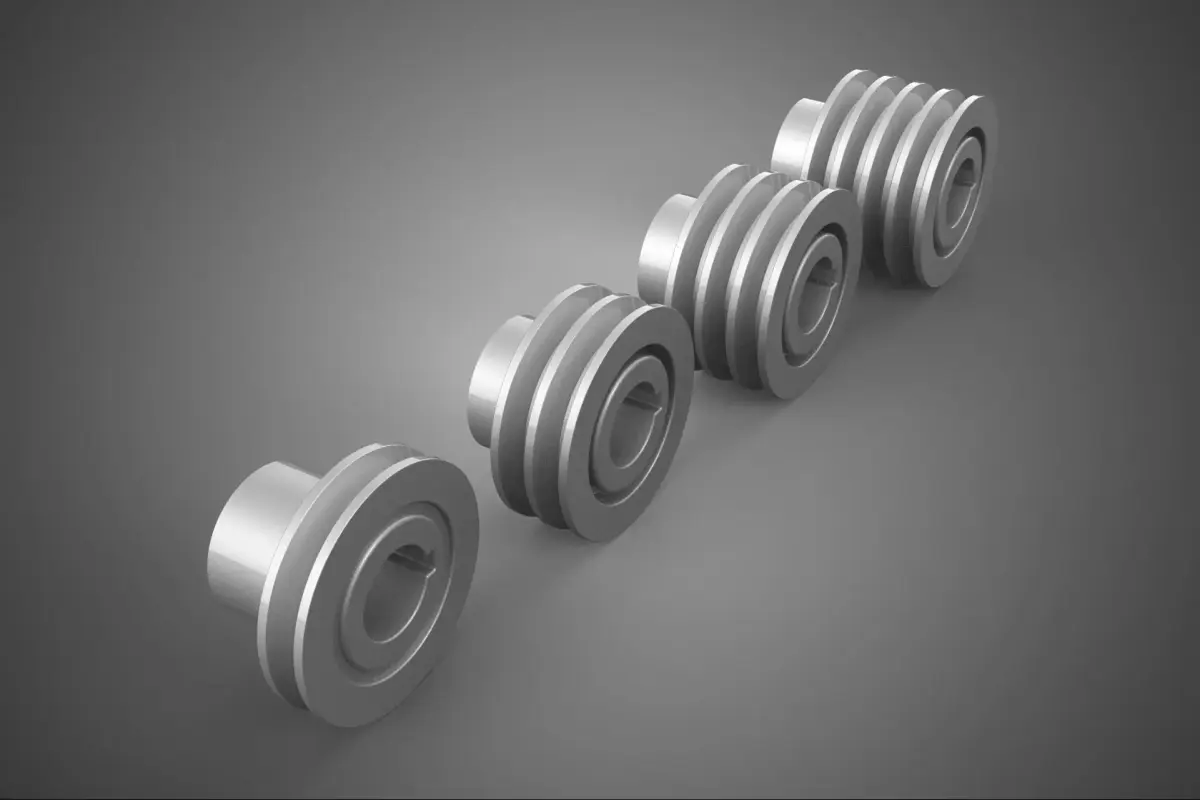
The component described by the compound terminology STANDARD PULLEY SHEAVE TRACK WHEEL DRIVE BELT GEAR MULTI GROOVE refers to a versatile mechanical wheel or disc utilized predominantly in power transmission systems, but also capable of serving as a guide or support mechanism. Objectively, this artifact is a circumferential body designed to interface with and transmit mechanical energy via flexible tensile elements (drive belts, cables, or occasionally chains), characterized primarily by the presence of multiple parallel grooves along its periphery.
1. Definition and Function
A Pulley (or Sheave) is a wheel on an axle or shaft that is designed to support movement and change the direction of a taut cable, belt, or drive chain, or to transfer power between two shafts. The designation Standard implies adherence to established industry metrics and profile standards (e.g., ISO, DIN, RMA, or specialized V-belt standards like 3V, 5V, A, B, C).
The primary function of the multi-groove configuration is to facilitate the simultaneous utilization of multiple individual belts or a single wide ribbed belt (Poly-V or serpentine belt). This design significantly increases the frictional contact area and enhances load distribution, enabling higher torque transfer capacity and improved operational stability compared to single-groove systems.
2. Nomenclature Clarification
The terminology used reflects the composite functions and design aspects of the component:
Pulley/Sheave: Generic terms for the wheel structure. While often used interchangeably, sheave frequently refers to components utilized in hoisting or cable systems, whereas pulley usually refers to those in belt-driven power transmission systems.
Multi Groove: This is the defining structural characteristic. The grooves are precisely machined circumferential depressions, ensuring positive tracking and standardized grip on the accompanying belt profile. Common profiles include standard V-belt profiles (trapezoidal grooves), synchronous (toothed) profiles (HTD, GT), and Poly-V (ribbed, shallow V-grooves).
Drive Belt: Confirms the primary application is transmitting rotational kinetic energy between shafts via friction or positive engagement belts.
Gear: This term is often applied loosely in industrial terminology. In the context of belt drives, Gear typically refers to a Timing Pulley or Synchronous Pulley, which utilizes teeth that mesh precisely with complementary teeth on a timing belt, achieving positive, slip-free drive akin to spur gears. Alternatively, it can imply that the assembly functions as an integral part of a reduction or multiplication gear train.
Track Wheel: This secondary designation indicates that the component, or variants sharing the multi-groove structure, can be designed to run along or guide movement parallel to a physical track or rail (e.g., in conveyor systems, material handling equipment, or specialized linear guidance applications), especially where the grooves serve to retain alignment.
### 3. Structural Characteristics and Materials
Multi-groove pulleys are engineered for precision and durability, requiring high concentricity and dynamic balance, particularly in high-speed applications.
Materials: The material selection is dictated by the operating load, speed, and environmental conditions:
Cast Iron (e.g., ASTM Class 30): Common for high-mass, industrial pulleys due to excellent damping characteristics and machinability.
Steel (Carbon or Alloy): Used for sheaves requiring high strength, impact resistance, or reduced mass (often fabricated or machined from bar stock).
Aluminum Alloys: Preferred in applications prioritizing low inertia, such as automotive drives or high-speed automation systems.
Engineered Plastics (e.g., Nylon, Acetal): Employed where lubrication is critical or corrosion resistance is necessary, typically in lighter duty applications.
Mounting: Pulleys are secured to shafts using various mechanisms, including set screws, keyways, taper-lock bushings (Taper-Lock), or quick-disconnect bushings (QD), ensuring secure torque transfer.
### 4. Operational Principles in Multi-Groove Systems
The mechanical advantage of using multiple grooves or ribs centers on efficiency and reliability:
Load Distribution: Multiple belts or ribs distribute the total transmitted load over a wider area, reducing the stress concentration on any single belt element and extending the service life of both the belts and the pulley bearings.
Increased Adhesion: The increased cumulative sidewall area provided by the grooves significantly boosts the effective coefficient of friction, minimizing slippage even under peak loads in friction drives (V-belts).
Stability: The redundancy of the multi-belt system maintains function even if a single element fails, and the design inherently reduces belt flutter and lateral vibration at high speeds.
### 5. Applications
Standard multi-groove drive components are ubiquitous across industrial, agricultural, and commercial sectors, including:
Industrial Machinery: Pumps, compressors, machine tools, crushers, and conveyors, often utilizing heavy-duty classical or narrow V-belt systems.
HVAC Systems: Large blowers, fans, and chillers requiring consistent, high-power input.
Automotive: Serpentine belt systems (Poly-V) that drive multiple accessories (alternators, power steering pumps, air conditioning compressors) from a single crankshaft pulley.
Agricultural Equipment: Tractors, combines, and harvesting machinery that rely on robust power transfer systems operating under variable conditions.
Included File Formats
This model is provided in 14 widely supported formats, ensuring maximum compatibility:
• - FBX (.fbx) – Standard format for most 3D software and pipelines
• - OBJ + MTL (.obj, .mtl) – Wavefront format, widely used and compatible
• - STL (.stl) – Exported mesh geometry; may be suitable for 3D printing with adjustments
• - STEP (.step, .stp) – CAD format using NURBS surfaces
• - IGES (.iges, .igs) – Common format for CAD/CAM and engineering workflows (NURBS)
• - SAT (.sat) – ACIS solid model format (NURBS)
• - DAE (.dae) – Collada format for 3D applications and animations
• - glTF (.glb) – Modern, lightweight format for web, AR, and real-time engines
• - 3DS (.3ds) – Legacy format with broad software support
• - 3ds Max (.max) – Provided for 3ds Max users
• - Blender (.blend) – Provided for Blender users
• - SketchUp (.skp) – Compatible with all SketchUp versions
• - AutoCAD (.dwg) – Suitable for technical and architectural workflows
• - Rhino (.3dm) – Provided for Rhino users
Model Info
• - All files are checked and tested for integrity and correct content
• - Geometry uses real-world scale; model resolution varies depending on the product (high or low poly)
• • - Scene setup and mesh structure may vary depending on model complexity
• - Rendered using Luxion KeyShot
• - Affordable price with professional detailing
Buy with confidence. Quality and compatibility guaranteed.
If you have any questions about the file formats, feel free to send us a message — we're happy to assist you!
Sincerely,
SURF3D
Trusted source for professional and affordable 3D models.
More Information About 3D Model :
The component described by the compound terminology STANDARD PULLEY SHEAVE TRACK WHEEL DRIVE BELT GEAR MULTI GROOVE refers to a versatile mechanical wheel or disc utilized predominantly in power transmission systems, but also capable of serving as a guide or support mechanism. Objectively, this artifact is a circumferential body designed to interface with and transmit mechanical energy via flexible tensile elements (drive belts, cables, or occasionally chains), characterized primarily by the presence of multiple parallel grooves along its periphery.
1. Definition and Function
A Pulley (or Sheave) is a wheel on an axle or shaft that is designed to support movement and change the direction of a taut cable, belt, or drive chain, or to transfer power between two shafts. The designation Standard implies adherence to established industry metrics and profile standards (e.g., ISO, DIN, RMA, or specialized V-belt standards like 3V, 5V, A, B, C).
The primary function of the multi-groove configuration is to facilitate the simultaneous utilization of multiple individual belts or a single wide ribbed belt (Poly-V or serpentine belt). This design significantly increases the frictional contact area and enhances load distribution, enabling higher torque transfer capacity and improved operational stability compared to single-groove systems.
2. Nomenclature Clarification
The terminology used reflects the composite functions and design aspects of the component:
Pulley/Sheave: Generic terms for the wheel structure. While often used interchangeably, sheave frequently refers to components utilized in hoisting or cable systems, whereas pulley usually refers to those in belt-driven power transmission systems.
Multi Groove: This is the defining structural characteristic. The grooves are precisely machined circumferential depressions, ensuring positive tracking and standardized grip on the accompanying belt profile. Common profiles include standard V-belt profiles (trapezoidal grooves), synchronous (toothed) profiles (HTD, GT), and Poly-V (ribbed, shallow V-grooves).
Drive Belt: Confirms the primary application is transmitting rotational kinetic energy between shafts via friction or positive engagement belts.
Gear: This term is often applied loosely in industrial terminology. In the context of belt drives, Gear typically refers to a Timing Pulley or Synchronous Pulley, which utilizes teeth that mesh precisely with complementary teeth on a timing belt, achieving positive, slip-free drive akin to spur gears. Alternatively, it can imply that the assembly functions as an integral part of a reduction or multiplication gear train.
Track Wheel: This secondary designation indicates that the component, or variants sharing the multi-groove structure, can be designed to run along or guide movement parallel to a physical track or rail (e.g., in conveyor systems, material handling equipment, or specialized linear guidance applications), especially where the grooves serve to retain alignment.
### 3. Structural Characteristics and Materials
Multi-groove pulleys are engineered for precision and durability, requiring high concentricity and dynamic balance, particularly in high-speed applications.
Materials: The material selection is dictated by the operating load, speed, and environmental conditions:
Cast Iron (e.g., ASTM Class 30): Common for high-mass, industrial pulleys due to excellent damping characteristics and machinability.
Steel (Carbon or Alloy): Used for sheaves requiring high strength, impact resistance, or reduced mass (often fabricated or machined from bar stock).
Aluminum Alloys: Preferred in applications prioritizing low inertia, such as automotive drives or high-speed automation systems.
Engineered Plastics (e.g., Nylon, Acetal): Employed where lubrication is critical or corrosion resistance is necessary, typically in lighter duty applications.
Mounting: Pulleys are secured to shafts using various mechanisms, including set screws, keyways, taper-lock bushings (Taper-Lock), or quick-disconnect bushings (QD), ensuring secure torque transfer.
### 4. Operational Principles in Multi-Groove Systems
The mechanical advantage of using multiple grooves or ribs centers on efficiency and reliability:
Load Distribution: Multiple belts or ribs distribute the total transmitted load over a wider area, reducing the stress concentration on any single belt element and extending the service life of both the belts and the pulley bearings.
Increased Adhesion: The increased cumulative sidewall area provided by the grooves significantly boosts the effective coefficient of friction, minimizing slippage even under peak loads in friction drives (V-belts).
Stability: The redundancy of the multi-belt system maintains function even if a single element fails, and the design inherently reduces belt flutter and lateral vibration at high speeds.
### 5. Applications
Standard multi-groove drive components are ubiquitous across industrial, agricultural, and commercial sectors, including:
Industrial Machinery: Pumps, compressors, machine tools, crushers, and conveyors, often utilizing heavy-duty classical or narrow V-belt systems.
HVAC Systems: Large blowers, fans, and chillers requiring consistent, high-power input.
Automotive: Serpentine belt systems (Poly-V) that drive multiple accessories (alternators, power steering pumps, air conditioning compressors) from a single crankshaft pulley.
Agricultural Equipment: Tractors, combines, and harvesting machinery that rely on robust power transfer systems operating under variable conditions.
Similar models

Find the models you need